
Strike up the fife and drums, we’re going to George Washington’s farm on this episode.
Visit us at maedunbroc.com
Music by Jason Shaw at AudionautiX
To find your next favorite book, visit our Bookshop.
Featured image courtesy of TripAdvisor
Transcript:
Hello Listeners,
Today is February 17, and this is A Garden A Day with Mædunbroc Gardens.
Thank you for listening.
Happy Presidents’ Day. I hope you are enjoying a day off today, and I hope you are spending it exactly the way you want to spend it.
As it is Presidents’ Day, I thought we should explore a garden associated with one of our presidents, and I chose for this episode not just any president, but our very first — and I think most people would agree — our best president — George Washington.
George Washington owned several farms throughout his life and was quite the plantsman.
I plan to visit several of them as the year progresses on this podcast, but I chose today’s garden — first, because of George Washington, but second because it’s the headquarters of the American Horticultural Society.
I thought since we are in February, and it’s time for many of us to start planning our own gardens, a mention of the American Horticultural Society would be appropriate.
So, where are we today? Today, we are exploring River Farm on the beautiful Potomac River in Alexandria, Virginia.
What we know as River Farm today spans twenty-five acres along the Potomac River and has been stewarded by the American Horticultural Society for more than fifty years, but its documented history goes back thousands of years.
In 1987, an archaeological dig at the farm unearthed arrowheads, stone tools, and evidence of encampments by indigenous peoples for thousands of years. The oldest artifacts discovered were a stone tool dated to about 3,000 BCE and a white quartz arrowhead that was dated as about 4,500 years old.
After the English arrived in the Chesapeake in 1607, Capt. John Smith explored the Chesapeake and its tributaries and noted Native American Indian tribes living along the Potomac.
In 1653 or ’54, the first Englishman to claim ownership of the land that was to become River Farm was Capt. Giles Brent. He patented 1800 acres for his year-old son, Giles, Jr. The area was called Piscataway Neck, and his wife, Mary, was a daughter of the chief of the Piscataway tribe.
From Giles Brent, Jr., the land went to a Brent cousin, George, and then eventually to the husband of Elizabeth Brent by 1739. Elizabeth was married to William Clifton, who renamed the farm Clifton’s Neck. By 1757, Clifton had built a brick house on the property which still stands today and serves as the headquarters of the American Horticultural Society.
Clifton had a few money problems and offered his farm for sale. After much back and forth, which George Washington called “shuffling behavior” it was in fact George Washington who purchased the farm in 1760. He renamed the farm River Farm.
Washington owned five farms, and River Farm was the northernmost farm of his holdings. He never lived on the farm or worked the land. Instead, he leased River Farm to tenant farmers.
In 1785, George Washington’s favorite nephew, also named George Washington, married Martha Washington’s favorite niece, Fanny Bassett. They resided with the elder Washingtons at Mount Vernon and had three children. The younger George died and Fanny went on to marry Tobias Lear, personal secretary and confidante to President Washington.
The President gave a lifetime lease to River Farm to Fanny and Tobias as a wedding present. You might remember that it was Tobias Lear who was at Washington’s side when he passed away and who recorded Washington’s final words as “’Tis well.”
Tobias Lear renamed the farm Walnut Tree Farm, and there is still one old black walnut tree that still stands on the farm today. Tobias outlived Fanny. She died of tuberculosis only a few months after their marriage. He died in 1816, and it is said he possibly still resides at River Farm. Spooky.
After Lear’s death, two more generations of Washingtons resided at Walnut Tree Farm. In 1859, Charles Augustine Washington sold 659 acres of River Farm to three Quaker brothers — Stacey, Isaac, and William Snowden. By this time, the farm was known as Wellington.
The Snowdens divided the acreage, and Isaac Snowden lived at the part that we know as River Farm.
In 1866, 280 acres of River Farm were sold again — this time to a group of men known as “The Syndicate.” Hmmmmmm.
By 1904, the house was run down, and it was sold again in 1912 to Theresa Thompson, part of the local family that owned Thompson Dairy. She made improvements to the house, but the biggest changes came in 1919 when the home was purchased by Malcolm Matheson. He transformed the home into the one visitors will see when visiting today.
In 1971, Matheson decided to sell the home and received an offer from the Soviet Embassy. Well folks, if it’s the 1970s, and you want to light a fire under someone’s behind, you tell them that the Soviets want to buy George Washington’s farm. Because folks, Congress intervened — and asked Mr. Matheson to take the property off the market, and he did.
One concerned citizen was Enid Annenberg Haupt, a member of the Board of Directors for the American Horticultural Society. She was once called the “patron saint of public gardens” and a “horticultural guardian angel” by the Los Angelas Times. She deserves her own episode, but for our purposes today, it was Enid Haupt, who by her own very generous nature, made possible the purchase Wellington by the American Horticultural Society. By that time, the estate had dwindled to twenty-seven acres. The society chose to call the estate River Farm in honor of our first president, George Washington.
In 1973, the society moved its headquarters to the farm, and there it has remained for more than fifty years.
River Farm today is a blend of formal and informal gardens, including a four-acre wildflower meadow, a dwarf fruit tree orchard, a children’s garden, and of course, spectacular views of the Potomac River.
The gardens surrounding the Manor House consist predominantly of native shrubs and trees with perennial and annual underplanting to provide ever-changing color throughout the seasons. Guests will discover oak leaf hydrangea, Allegheny serviceberry, and fringe tree.
On the side of the Manor House, visitors will find 100 year old English boxwood.
The Garden Calm provides shade and a respite from the summer heat. There is an Osage Orange tree located in this garden that is more than 200 years old.
The Children’s Garden offers several child-size gardens designed to provide a multi-sensory experience to engage children in imaginative and hands-on play. A miniature boat, a pioneer cabin similar to one Laura Ingalls might recognize, and even a small bat cave are open for exploration.
The Clara B. Plein Memorial Gardens demonstrates how a garden can balance traditional horticultural practice while also supporting native ecosystems. The garden contains 68% native plants and 32% native cultivars. A list of the plants installed in the garden can be found on the AHS website. I’ve included a link in the notes.
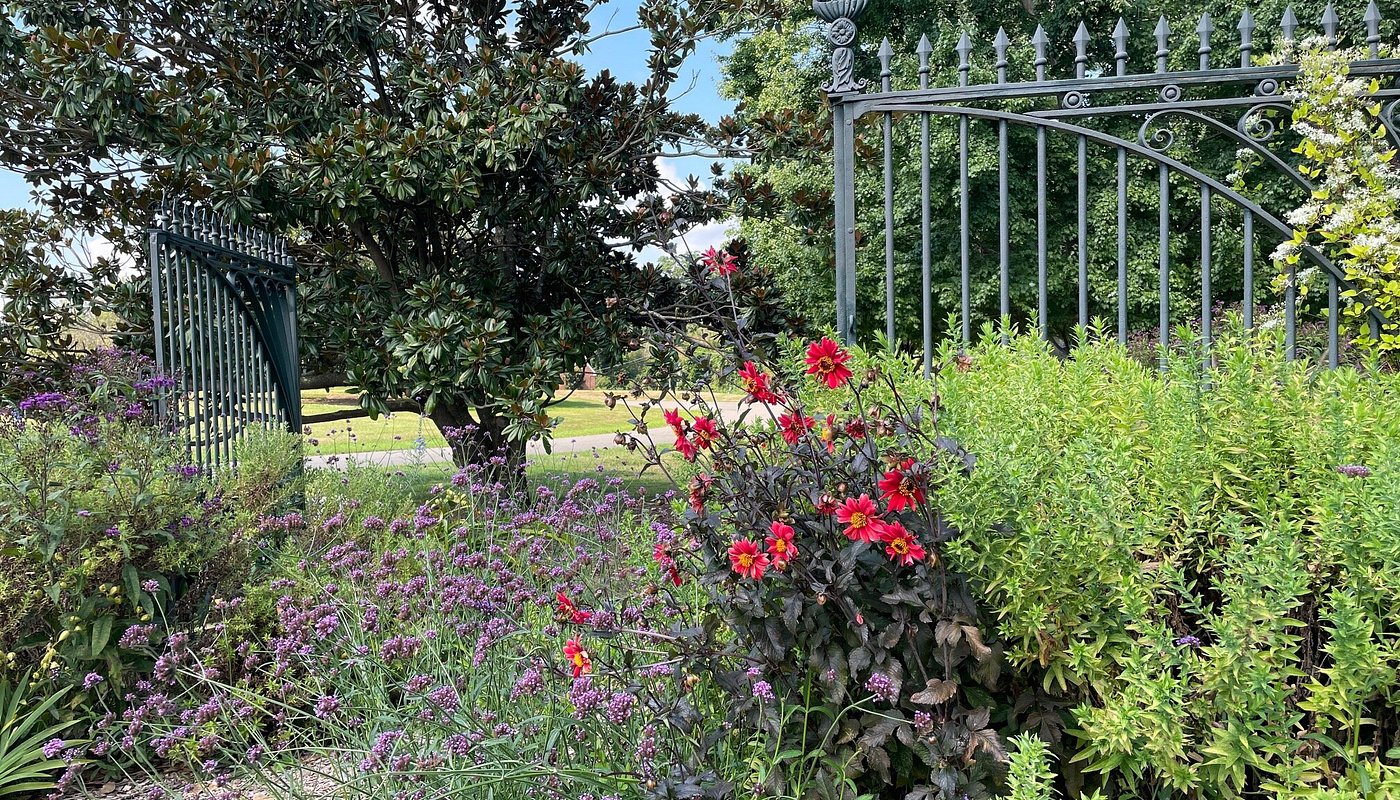
There are a series of perennial borders with plants selected for insect and disease resistance. Plants are coordinated by color, size, and texture.
At one end of the perennial borders stand the White House Gates. They were first installed at the White House in 1819 as part of the repairs to the house resulting from damage that occurred during the War of 1812. They stood at the White House for more than 120 years. They found a new home at River Farm and were restored in 2004.
There are more plants to see on these twenty-five acres, and I do hope you will find the time to visit.
The American Horticultural Society hosts a Spring Market each year. This year, the market will be held on April 11 and 12 from 9:00- 3:00 both days. This is one of the largest fundraisers for the AHS, and it’s always a good time for everyone who attends. Vendors are on hand selling native plants, herbs, garden wares, house wares, flowers, bath and body products, and of course, food. No spring market is complete without food! There is a fee for entry to the Spring Market, but AHS members can attend for free.
The farm is a popular spot for weddings, corporate meetings, and other special events as well as more casual strolls through the gardens, picnics, plein-air painting, and birdwatching.
Admission to River Farm is free. The farm is open Monday-Friday 9:00-5:00. For the rest of this month, the farm is open on Saturdays from 9:00-4:00, but beginning in March, the farm will close at 1:00 on Saturdays. The farm also closes early for special events, so you might want to check with the garden before you go, so you don’t get any surprises once you arrive.
Well, that’s about it for today. I hope you’ve enjoyed today’s garden.
Thank you so much for listening. Join me tomorrow to find out where we are going next. I release a new episode every single day.
As a reminder, you can learn more about the gardens featured on A Garden a Day by clicking on the links in the notes or by visiting our website, agardenaday.com.
And if you like A Garden a Day, and I hope you do, please consider liking, subscribing, and telling your friends. If you are able, please also consider giving us a five-star review. It lets me know you like the show, and it also helps others find the podcast. I really do appreciate your support.
If all goes well, I will be right back here tomorrow. See you then!
To learn more about River Farm or the American Horticultural Society, visit these links:
https://ahsgardening.org/about-river-farm/
https://en.wikipedia.org/wiki/River_Farm
https://ahsgardening.org/completehistoryofriverfarm/
https://www.virginia.org/listing/american-horticultural-society’s-river-farm/7789/
https://visitalexandria.com/listings/american-horticultural-societys-river-farm/
https://www.funinfairfaxva.com/peaceful-river-farm-alexandria-virginia/
https://www.riverexplorer.com/details.php?id=307
https://ahsgardening.org/about-river-farm/virtual-tour/clara-b-plein-memorial-garden/



Leave a Reply