
This is not just any garden. This is Kew.
Visit us at maedunbroc.com and agardenaday.com
Music by Jason Shaw at AudionautiX
Featured image courtesy of Jay Minter — On the List
Buy your new favorite book from Mædunbroc Gardens Bookshop
Transcript:
Hey there, Garden Lovers,
Today is February 7, and this is A Garden A Day with Mædunbroc Gardens.
Thank you for listening.
Few places immediately get the heart racing as fast as the mention of today’s garden. The eyes widen with a twinkle. A smile slowly forms on even the stodgiest of faces. Everyone stands a little taller.
Today’s garden is a UNESCO World Heritage Site. It maintains the largest plant conservation program in the world. It cares for the most diverse collection of living plants in the world. It employs more than 470 scientists as a world leading scientific research center, and it partners with more than ninety botanical gardens around the world to research, understand, and protect the world’s plant and fungal biodiversity.
Ok, Gardeners, get giddy because today, we are in southwest London, in jolly old England at Royal Botanic Gardens, Kew.
The Royal Botanic Gardens at Kew are actually two gardens — Kew in the borough of Richmond on Thames just outside of London’s city center and Wakehurst about an hour’s drive away in West Sussex.
I’m going to save Wakehurst for its own episode sometime in the future, but I do want to mention here before we move on that Wakehurst is the home of Kew’s Millennium Seed Bank, a project begun in 1996 to collect and store seeds for future generations. The project is intended as an insurance policy against plant extinction. The seed bank works with global partners to bank seeds of plants that are most threatened and provide the most usefulness for the future. So far, the program has banked seeds from more than 15% of the world’s plants.
Royal Botanic Gardens, Kew began in 1759 as a nine-acre garden for exotic plants set within the pleasure grounds of Kew Palace. The garden was established by Princess Augusta, the mother of King George, III — for our American audience — yes, THAT King George.
Moving on.
The garden grew in collections and esteem with the work of Joseph Banks. He first sent seeds to Kew while on Captain Cook’s first voyage between 1768 and 1771. When he returned from the voyage, he became an unofficial advisor to King George, III, on the royal gardens at Kew. He sent explorers and botanists around the world to find plants and bring them back to Kew. Banks is credited with bringing 30,000 specimens to England and introducing popular plants such as eucalyptus and acacia.
By the middle of the 1800s, the Royal Botanic Garden, Kew became a center for scientific research. In 1840, Kew was transferred from the Crown to the government, and the garden opened to the public.
Botanist William Jackson Hooker became the first director of Kew in 1841.
Through his work and the subsequent work of his son, Joseph Dalton Hooker, who succeeded him as director, Kew became the pre-eminent center for scientific research and international exchange of plant specimens.
The Herbarium was built in 1852, and today contains more than seven million specimens. Kew also boasts a Fungarium with a collection of more than one and a quarter million fungal specimens.
Today, Royal Botanic Gardens, Kew spans 326 acres and includes forty historically important buildings, including three glass houses, two art galleries, the Great Pagoda, Queen Charlotte’s Cottage, and of course, Kew Palace, also known as the Dutch House.
The largest Victorian glasshouse in the world stands tall at Royal Botanic Gardens, Kew. The Temperate House contains over 10,000 plants from temperate regions including 1,500 species from five continents and 16 islands. Built in 1863, the Temperate House is home to some of the world’s rarest and most threatened plants.
Another Victorian glasshouse — the Palm House — is home to a unique collection of tropical plants from all over the world. The Palm House was built in 1844 to provide a rainforest climate with the express purpose of housing specimens brought back by Victorian explorers to far off tropical climes. Inside the glasshouse, a rainforest environment is recreated with layers including a canopy of palms and other trees, climbers, and epiphytes and shorter understory plants.
Many plants in this collection are endangered in the wild — some are even extinct in the wild. Many are grown for economic or medicinal purposes. Some of the plants include the rubber tree, coffee, cacao, and sugarcane.
The Palm House is also unique for its architecture. Its design was inspired by ship builders and looks like an upturned ship’s hull.
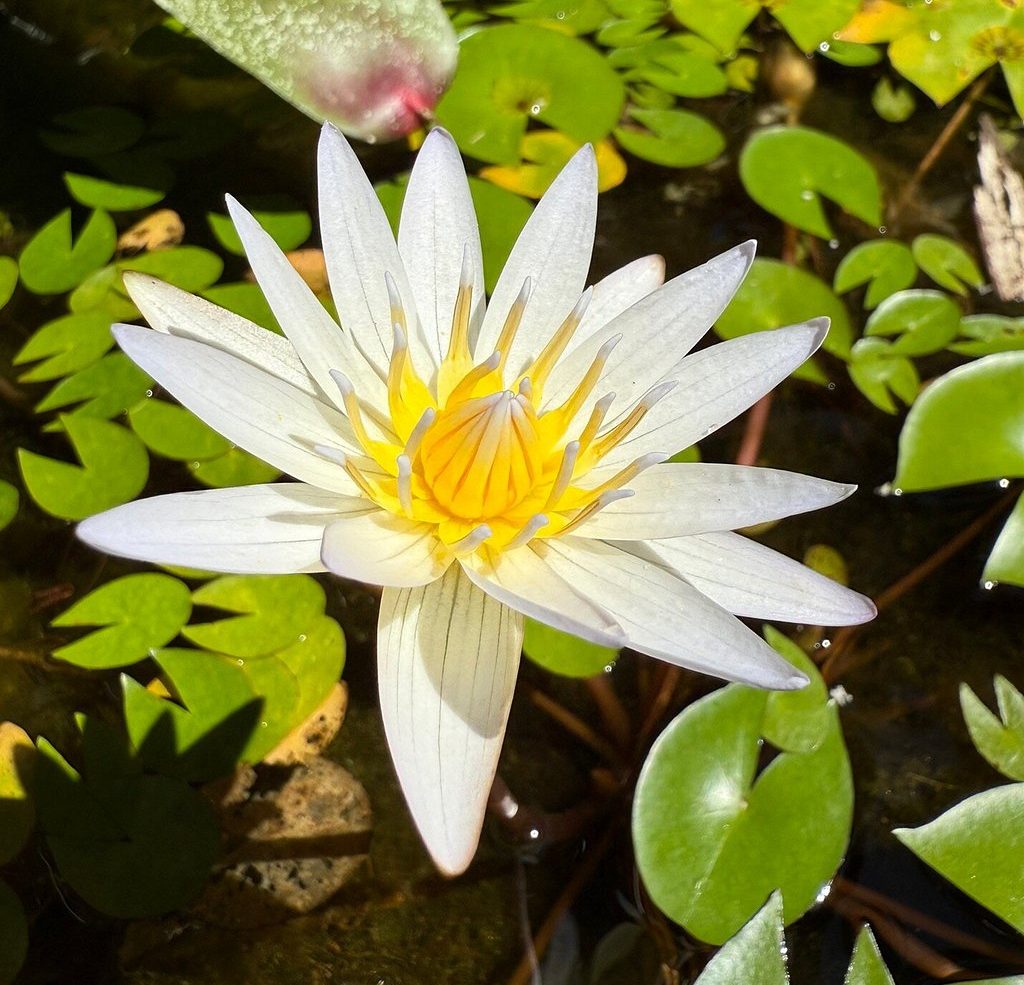
Located next to the Palm House is the Waterlily House, the second oldest glasshouse at Kew, completed in 1852. The house contains a 32 foot circular pond and is the hottest and most humid of the glasshouses. The Waterlily House was designed especially to house the Amazon waterlily (Victoria amazonica). The giant lily pads are so large that a small person, some say up to about 100 pounds, can sit or stand on one of these lily pads.
There are lots of pictures online of people, mostly children, who’ve achieved this feat. I’ve included a link in the notes to a photograph of a young Miss Cotton, likely the daughter of Arthur Cotton, Herbarium Keeper of the time, posing on a lily pad in 1923.
The water in the pond is black which is the result of a harmless dye added to help control algae growth. There are also fish swimming along in the pond for the same purpose.
In summer, the Waterlily House is also home to lotus and papyrus. While in autumn, visitors will enjoy a selection of gourds.
The Princess of Wales Conservatory is one of the newer glasshouses and the most complex. It opened in 1987 and contains ten different computer-controlled climate zones ranging from temperate to tropical to arid. Each zone is an immersive experience showing the diversity of climates and the varying needs of different species of plants.
Ferns are located in both tropical and temperate zones to show the needs of ferns from two different kinds of climate systems. Orchids are also found in two different climates — hot and steamy zone for epiphytic varieties and cooler zone for orchids that root in soil.
Wet tropics represent rainforests and mangroves with a delightful selection of carnivorous plants such as Venus flytrap and pitcher plants.
Dry tropics represent the arid regions of the world. Here you will find plants such as cacti, agave, and aloe.
Outside, visitors will enjoy the beauty and majesty of Kew’s Arboretum. There are 14,000 trees at Kew that cover more than two-thirds of the entire garden. Many of the trees have been there since the gardens were founded more than 260 years ago. Within that 14,000 are 2,000 different species. The tallest tree in the gardens is American — the coastal redwood (Sequoia sempervirens). The tree is 131 feet tall or as tall as a 13-story building.
To enjoy a birds-eye view of the trees, visitors can stroll along the Treetop Walkway. The walkway stands fifty-nine feet in the air allowing visitors to experience a different perspective on this nature trail in the sky.
The Great Broad Walk is another way to enjoy the outdoors at Kew. Extending over 1,000 feet, the Great Broad Walk contains more than 60,000 flowering plants and is the longest double herbaceous border in the world.
And speaking of best in the world, what kind of podcast host would I be if I didn’t mention the garden’s inclusion in the Guinness Book of World Records for 2022? The garden earned the record for ‘largest collection of living plants at a single-site botanic garden.’
The garden is home to almost 17,000 species of plants and about 60,000 plantings.
If you are not able to visit in person, you can visit one of their online databases. They maintain a site called Plants of the World Online. Its purpose is to provide a single point of access for information on all the seed-bearing plants in the world. I’ve included a link to the site in the notes.
Plants aren’t the only things to see at Royal Botanic Gardens, Kew. Art and architecture play a role, too.
Two art galleries dedicated to botanical art are located on site. The Marianne North Gallery includes more than 800 of the artist’s works. The Shirley Sherwood Gallery of Botanical Art showcases botanical illustration from the time before photography to present day. The Shirley Sherwood Gallery was the first art gallery in the world dedicated to botanical art.
Visitors interested in history and architecture will enjoy a visit to Kew Palace also known as the Dutch House. It was built in 1631 for London silk merchant, Samuel Fortrey.
In the 1720s, King George, II, and his wife, Queen Charlotte moved their children there as a refuge. Kew was a secluded and quiet spot, away from the public gaze in London.
The home was used as the summer palace for King George, III, and the place where he stayed during bouts of illness.
From 1809, the royal family rarely visited Kew Palace, but in 1818, Queen Charlotte was taken ill while traveling from London to Windsor and stopped at Kew recuperate. Her health never improved, and she died there in November of that year.
Queen Victoria’s children briefly spent time at Kew Palace in 1844, but from I could find, that was the last time anyone from the royal family stayed at the palace.
In 2006, Queen Elizabeth, II, celebrated her 80th birthday at Kew Palace with a family birthday dinner.
The Royal Kitchens are also open for visitors. Closed permanently in 1818 after the death of Queen Charlotte, the kitchens remained closed for nearly 200 years. The kitchens opened for visitors in 2012.
Queen Charlotte’s Cottage sits amidst a 300-year-old bluebell wood. It was a special place for the king and queen and their children to rest and enjoy tea. The house was built in a rustic style for the time. It is timber-framed with brick infill and has a thatched roof. The Picnic Room in the house has a flower garland trellis painted on the walls which is believed to have been painted by Princess Elizabeth, daughter of King George and Queen Charlotte.
The Great Pagoda is another building worth visiting. It was completed in 1762. The building is 163 feet tall with a challenging 253 steps to reach the top. Eighty colorful, wooden dragons adorn each level.
These historic buildings are maintained by Historic Royal Palaces.
Several dining options are available in the garden from casual to formal, quick bite or sit down. Picnics are also allowed throughout the garden, so feel free to bring your own basket.
There is so much more to see and do and learn at Royal Botanic Garden, Kew, including the 800 rhododendrons in the Rhododendron Dell, the rose garden, the children’s garden, the kitchen garden, and so much more.
The garden opens every morning at 10:00 and is open everyday except Christmas Eve and Christmas Day. The Palace, Royal Kitchens, Queen Charlotte’s cottage, and Great Pagoda are closed for winter but should open closer to Easter and remain open through summer.
From bulbs and cherry blossoms in spring to scented blossoms in summer, changing colors in autumn to warm and humid glasshouses in winter, there is always something to see at Royal Botanic Gardens, Kew.
Well, that’s about it for today. I hope you’ve enjoyed today’s garden.
Thank you so much for listening. Join me tomorrow to find out where we are going next. I release a new episode every single day.
As a reminder, you can learn more about the gardens featured on A Garden a Day by clicking on the links in the notes or by visiting our website, agardenaday.com.
And If you like A Garden a Day, and I hope you do, please consider liking, subscribing, and telling your friends. If you are able, please also consider giving us a five-star review. It lets me know you like the show, and it also helps others find the podcast. I really do appreciate your support.
If all goes well, I will be right back here tomorrow. See you then!
To learn more about Royal Botanic Gardens, Kew, check out these links:
https://powo.science.kew.org/
https://www.hrp.org.uk/kew-palace/#gs.jo8wjv
https://www.visitlondon.com/things-to-do/place/58711-royal-botanic-gardens-kew
https://unesco.org.uk/our-sites/world-heritage-sites/royal-botanic-gardens-kew
https://en.wikipedia.org/wiki/Royal_Botanic_Gardens,_Kew
https://kew.gardenexplorer.org/Default.aspx
https://artsandculture.google.com/partner/kew-royal-botanic-gardens


Leave a Reply