
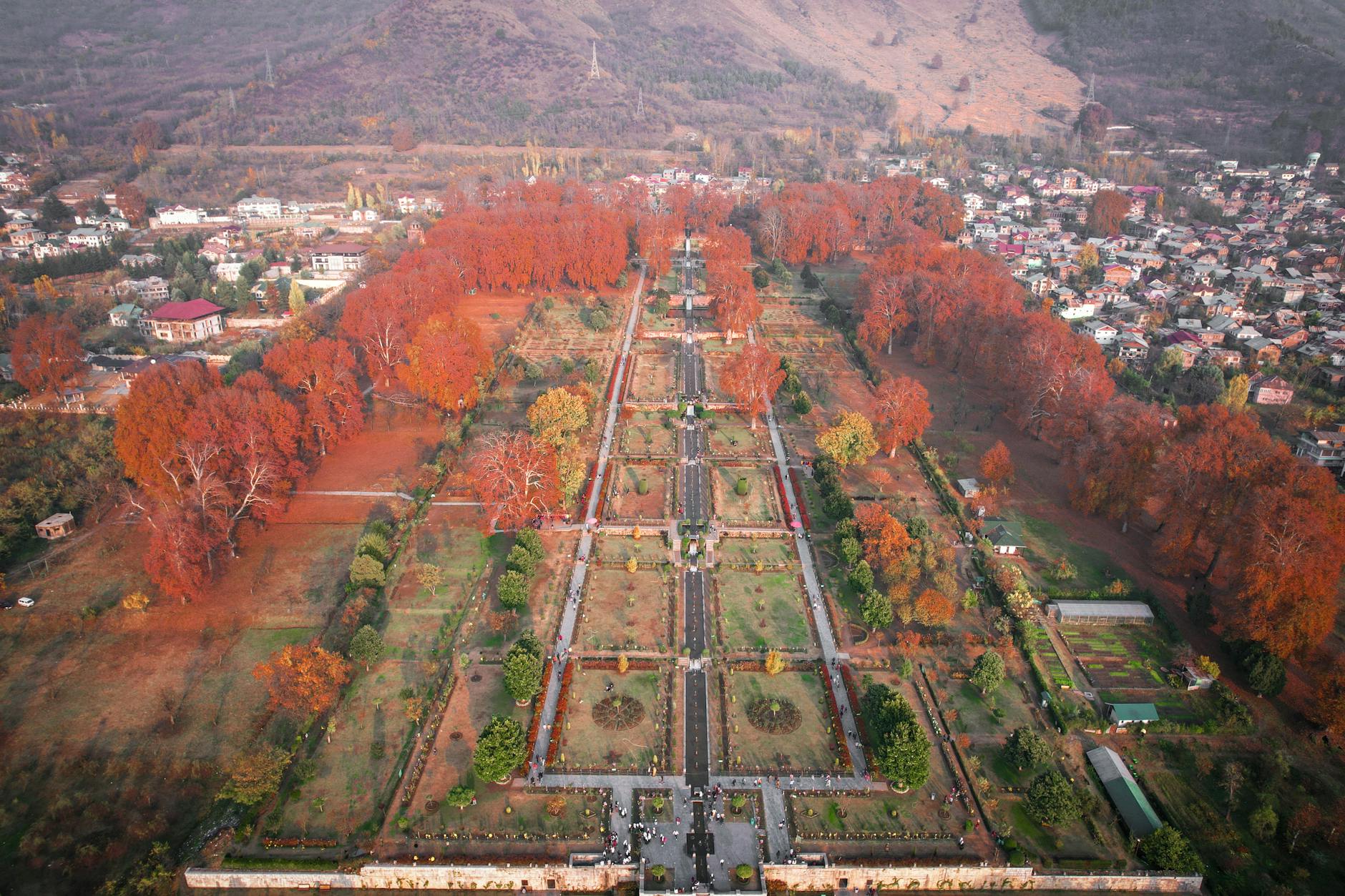
This garden is called the Garden of Love and paradise on earth.
Visit us at maedunbroc.com
Music by Jason Shaw at AudionautiX
To find your next favorite book, visit our Bookshop.
Featured image courtesy of Imad Clicks via Pexels
Transcript:
Hello Listeners,
Today is February 15, and this is A Garden A Day with Mædunbroc Gardens.
Thank you for listening.
“If there is a paradise on earth, it is here, it is here, it is here.” So wrote 16th century Persian poet Orfi Shirazi on his visit to Kashmir, possibly in the year 1588.
It is inscribed on the black marble pavilion installed over a waterfall on a terrace of today’s garden.
So where is this paradise on earth? Today, we are exploring The Garden of Love — Shalimar Bagh in Srinigar in the Kashmir region of India.
Shalimar Bagh was built in 1619 for Noor Jahan, wife of Emperor Jahangir. The couple were so enamored with Kashmir, that they moved their full court to Shalimar Bagh each summer for thirteen years.
The garden has been described as having serene beauty and is a testament to Mughal horticultural mastery. The garden was designed in a traditional Persian style with three terraces, each with its own purpose.
The first terrace was built for public audiences. Court assembled in the gardens, and this was an open space for the public. There are four pavilions on this terrace designed for rest and contemplation. They are named for the four seasons. Emperor Jahangir called this terrace garden Farah Baksh meaning ‘the delightful.’
The second terrace was a private space for nobility. This area was designated for the emperor’s family and friends. There are two pavilions on this terrace at either end. One is named for the rose garden. The other is called the garden of grace. This terrace is called Faiz Baksh or “the bountiful.”
The third terrace was set aside as a private space only for Jahangir and Noor Jahan. It contains a pavilion in the center designed as the royal residence and thrown room. The pavilion is called Sheesh Mahal or palace of mirrors.
The garden was linked to nearby Dal Lake by a mile-long canal. The canal runs through the center of the garden and features a line of fountains down its center. Water from the canal feeds the 410 fountains found on first terrace.
Jahangir’s son and successor, Shah Jahan, also loved the garden. He added a fourth terrace with a pavilion that served as his palace and throne room. The fourth terrace is the highest and the largest. With his expansion of the garden, Shalimar Bagh became even more regal and spectacular.
As a side note, Shah Jahan, you might remember, is responsible for building the Taj Mahal.
And I should also mention here that there are two other Shalimar Gardens — one in Delhi and another in Lahore, Pakistan. Those two gardens were also built by Shah Jahan as a tribute and replica of this first Shalimar Garden.
Today, Shalimar Bagh spans 31 acres. The main gate leads to a courtyard where visitors will find a small museum displaying artifacts relating to the garden.
Many repairs and renovations have occurred throughout the four centuries since the garden was created.
Chinar trees or Eastern planes grow throughout the garden. The trees are native to Kashmir and are considered a symbol of the valley, and some of these trees are as old as the garden — more than 400 years old.
Jasmine, roses, orchids, lilies, tulips, daffodils, and hyacinths offer visitors abundant blooms and sweet, floral scents.
The garden also hosts a number of fruit trees — apple, peach, plum, pear, cherry, and apricot.
The garden is known for its chini khanas, or arched niches, that once held lanterns but now contain potted plants.
Various statues are found throughout the garden in copper, brass, and silver. They depict natural subjects such as fish, elephants, lotus, and the sun, while frescoes adorn the walls and ceilings of the pavilions.
Colors are more vibrant in spring when most of the flowers are in bloom and autumn when the leaves of the trees are changing color, but a visit to the garden is delightful and bountiful all year long.
Well, that’s about it for today. I hope you’ve enjoyed today’s garden.
Thank you so much for listening. Join me tomorrow to find out where we are going next. I release a new episode every single day.
As a reminder, you can learn more about the gardens featured on A Garden a Day by clicking on the links in the notes or by visiting our website, agardenaday.com.
And If you like A Garden a Day, and I hope you do, please consider liking, subscribing, and telling your friends. If you are able, please also consider giving us a five-star review. It lets me know you like the show, and it also helps others find the podcast. I really do appreciate your support.
If all goes well, I will be right back here tomorrow. See you then!
To learn more about Shalimar Bagh, check out these links:
https://en.wikipedia.org/wiki/Shalimar_Bagh,_Srinagar
https://vargiskhan.com/log/shalimar-bagh-srinagar-entry-fee-timings-trip-planning/
https://srinagar.nic.in/tourist-place/shalimar-garden/
https://searchkashmir.org/2009/04/history-of-shalimar-bagh.html
https://www.kashmirhills.com/gardens/shalimar-bagh-in-srinagar/
https://www.holidify.com/places/srinagar/shalimar-bagh-sightseeing-3658.html
https://eindiatourism.in/shalimar-bagh/
https://www.tourmyindia.com/states/jammu-kashmir/shalimar-garden.html
https://www.archnet.org/sites/5011?media_content_id=3310
https://digital.library.cornell.edu/catalog/ss:3856942
https://www.indiautentica.com/travel/mughal-gardens-of-srinagar/
https://www.indianholiday.com/jammu-and-kashmir/tourist-attraction/srinagar/shalimar-garden.html


Leave a Reply