Join me on the French Riviera for this garden adventure.
Visit us at maedunbroc.com
Music by Jason Shaw at AudionautiX
To find your next favorite book, visit our Bookshop.
Featured image courtesy of Villa et Jardins Ephrussi de Rothschild
Transcript:
Hello Listeners,
Today is February 1, and this is A Garden A Day with Mædunbroc Gardens.
Thank you for being here.
Before I talk about today’s garden, I want to take a few minutes to thank you. We’ve completed our first full month of A Garden a Day, and we’re off to a great start. We have listeners all over the world, and I’m so grateful for each and every one of you. So thank you!
Now, on with the show.
When John Mellancamp sang of a little pink house, I don’t think he was singing about today’s subject.
It’s definitely pink, but it’s not little.
Extravagance. Opulence. An eccentric owner. Yes, please. Thank you very much.
Today, we are high on a hilltop overlooking the Mediterranean Sea on the French Riviera, in Saint Jean-Cap-Ferrat at the Gardens and Villa Ephrussi de Rothschild.
The color pink is the name of the game at today’s garden as pink was the favorite color of this villa’s owner, Baroness Béatrice Ephrussi de Rothschild.
The facade of the villa is pink. The Venetian marble on the interior of the villa is pink. The flowers planted in borders are several shades of pink.
You will find pink balsam, pink impatiens, pink roses.
Even the owner of the villa was known to dress in pink from head to toe.
Charlotte Béatrice de Rothschild was born into one of Europe’s wealthiest families — the Rothschild banking dynasty. She grew up with art, beauty, and wealth. She was a member of Paris high society and grew up in an opulent palace in Paris and an enormous chateau in the French countryside.
She had interests in art, music, theatre, architecture, literature, and horticulture.
When she was nineteen years old, she married Maurice Ephrussi, a thirty-four year old banker known to her father in a possibly arranged or strongly encouraged marriage. Beatrice and Maurice shared a love of beauty, art, and architecture, and collected many works of art and rare objects. They maintained homes in Paris and Monte Carlo.
What Maurice did not seem to love was loyalty, commitment, or fidelity. He was a notorious womanizer and gambler, racking up huge debts. SCANDAL!
In 1904, his debts totaled twelve million gold francs. I’ve seen this figure as the equivalent of about thirty million euros today, so the Rothschilds, worried for their financial future, took him to court asking for a separation. The court sided with the Rothschilds, and after twenty-one years of marriage, Maurice and Beatrice separated.
The following year, Beatrice’s father died, leaving Beatrice a considerable inheritance, and she started an independent life of her own.
While love might have eluded her in marriage, she did fall in love with the French Riviera. She purchased seventeen acres of land on a peninsula with breathtaking panoramic views of the Mediterranean Sea and instructed her builders to build her a Venetian-style palazzo. Construction began in 1905. She worked and re-worked the design until seven years later, she had the Villa she desired.
The home became her winter residence for over a decade.
She filled the villa with over 5,000 works of fine art including paintings by Old Masters, a collection of rare porcelain, sculptures, and antique furniture.
She even created a small zoo within the gardens and kept monkeys, flamingos, antelope, gazelles, and mongooses.
The villa is a perfect example of its time — the Belle Époque — or Beautiful Era where beauty, luxury and leisure intertwined.
And the beauty extends to the meticulously manicured gardens.
There are nine dream gardens at the villa with colonnades, waterfalls, ponds, dancing fountains, flowerbeds, and trees of rare species.
The French Garden is the largest of the gardens. It was designed in the shape of the deck of an ocean liner with water on both sides, so that when viewed from the terrace of the villa, Beatrice could imagine herself on a ship traveling the world while she looked at her garden.
She even had her gardeners dress like sailors wearing blue berets with red pom poms to look like the crew of a ship.
This formal garden includes a large central pool with dancing water fountains, clipped hedges, and colorful bedding plants.
At the top of the French Garden is the dome and column Temple of Love. From the Temple, water gently cascades down to the canal step by step framed by pink begonias.
The Spanish Garden also contains a water feature. A canal was built down its center, bordered by flowers. The scents of honeysuckle and jasmine greet visitors as they stroll among the pomegranate and olive trees.
The Lady Banks Rose, a yellow rose, is over one hundred years old and is found here. The walls of the garden are covered in bougainvillea and Inca lilies, and there is a hidden grotto located behind the pink columns.
Pink bedding plants greet visitors in the Sevres Garden. This is the smallest garden and runs along the side of the villa and tea room.
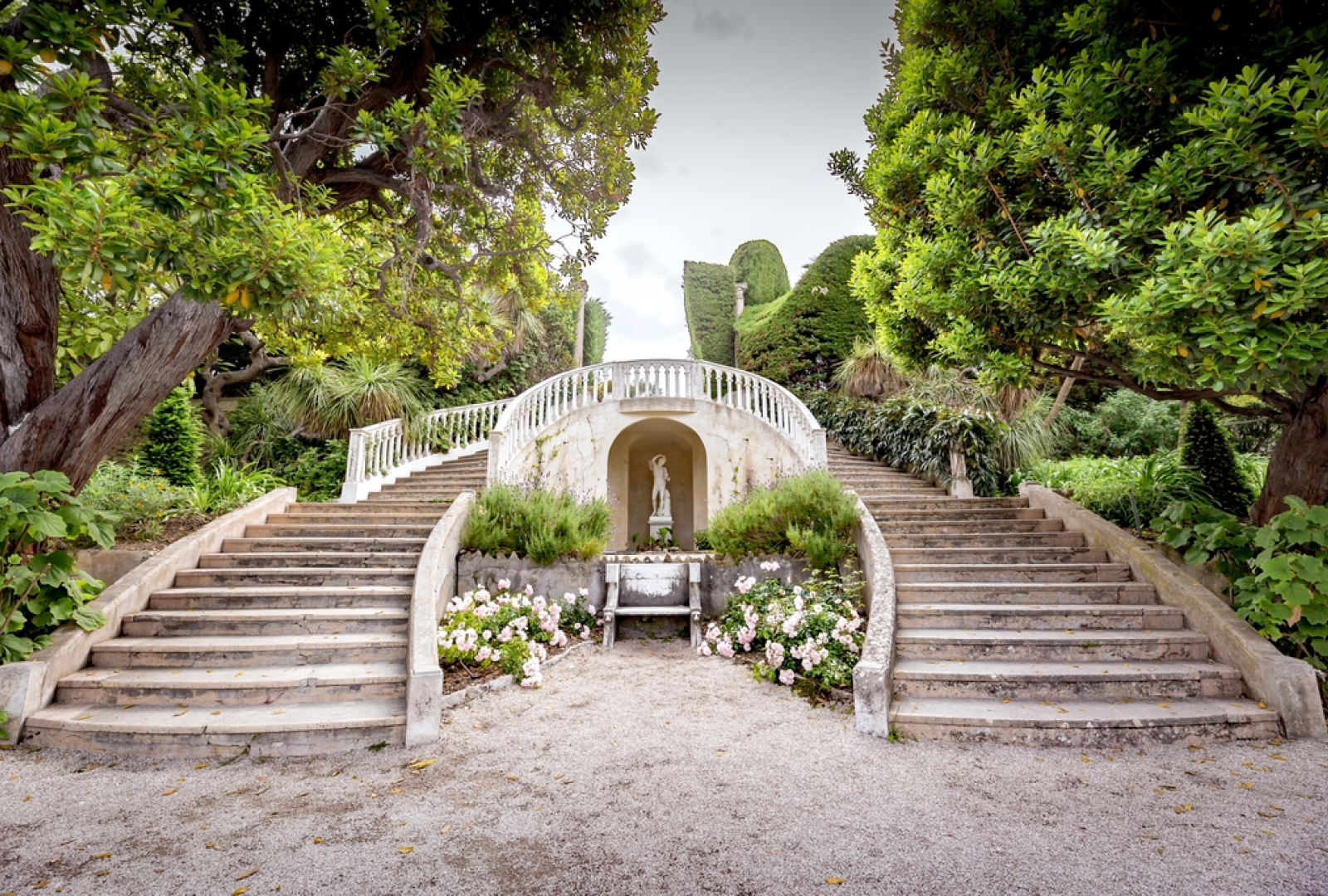
A horseshoe staircase with a statue at its center, titled, “The Zephyr thwarting the loves of a rose and a butterfly” by the artist Boyet invites visitors to explore the Florentine Garden, reminiscent of the Italian Renaissance, and bordered by cypress.
The Lapidary Garden or Stone Garden includes sculptures dating from the Middle Ages and Renaissance, Bas-reliefs, gargoyles, arches, fountains and canopies. Mixed with the stoneworks are camellias and hydrangeas, camphor trees, and rhododendrons. The walls are draped with dwarf creeping fig that provides the backdrop for the fragments of buildings, arches, and columns. — This garden is nice all year, but it does give off a bit of a Halloween-y vibe in autumn, if you’re interested.
Another water feature is found in the Japanese Garden. The garden was designed for meditation and relaxation and includes a koi pond — you know how much I like a good koi pond — Japanese maples, azaleas, rhododendrons, and camellias.
All structures, including lanterns, bridges, and pavilions, in the Japanese Garden are made out of wood.
The Exotic Garden was once called the Mexico Garden and contains a large collection of succulents and cacti, palm, ginger, and bamboo. Here, you will find aloe and prickly pear, purple epiphytes and red bromeliad.
The Rose Garden is completely devoted to roses save for the hedges that border the garden path. There was once a Beatrice rose, but an unusual cold spell destroyed the flower. Since 2019, efforts have been made to bring back the rose.
And finally, the Provence Garden is classic Provence with scenery that fills the region. Here, visitors will find olive and cypress trees, rosemary, lavender, and agapanthus.
The smell of lavender, roses, and clean sea air greet you when you arrive at Villa Ephrussi de Rothschild.
The gardens are designed to bloom at different times of the year, so even in winter, there is something beautiful to see.
Today, the gardens are tended with an eco-friendly approach. For more than a decade, the professional gardeners in charge have eschewed synthetic chemicals and adopted organic methods. No herbicides are used in the gardens. They use essential oils of clove and lemon to treat weeds. The result is an increase of biodiversity. Hedgehogs, mallard ducks, herons, and frogs have returned to the garden.
The villa hosts several events throughout the year.
The Festival of Roses and Plants — in May — celebrates the arrival of spring. The gardens are all decked out in pink. Rose growers show different species of roses. The event includes live entertainment, workshops, and tours.
In June, the gardens open to artists on The Painters Day, inviting artists to find inspiration in the garden to heighten their art.
This summer, visitors can experience a magical evening show of music, dance, and poetry. The facade of the villa will be illuminated by 1500 candles and lanterns with a musical water show occurring every twenty minutes. Visitors will be able to stroll through the romantically lit gardens while enjoying artistic performances. A wine and champagne bar will be available and gourmet baskets will be available for purchase. Visitors are invited to bring their own blanket to dine al fresco on the lawn. The event called Les Nocturnes happens every Monday and Tuesday from July 14 to August 26.
During winter, the Villa hosts Thursdays at the Villa, a weekly 21st century salon that combines intellectual curiosity with gastronomic pleasure. Each week, specialists in the areas of history, science, culture, and the arts gather with guests to discuss topics shaping our society — all while enjoying a gourmet meal designed by the head chef of the onsite restaurant.
And speaking of food, there is an elegant tearoom onsite located in the former dining room. Visitors can also enjoy dining outside on the terrace under the orange trees overlooking Bay Villefranche.
When Beatrice passed away in 1934, she left the villa and gardens to the Academie des Beaux-Arts. She wanted the home turned into a museum which it was. The museum stayed open until World War II.
During the war, the house was looted and the gardens were left to grow wild. After the war, the Academie reclaimed the villa and restored the home and gardens. They painted the facade pink and renamed the villa the Villa Ephrussi de Rothschild.
The facade was originally ochre, and the original name was Villa Ile de France.
In 1996, it was designated a historical monument in France and is classified as a “Remarkable Garden” by the Ministry of Culture
The villa and gardens are open year round and tours of the villa are available.
Well, I guess that’s about it for today.
Thank you so much for listening. Join me tomorrow to find out where we are going next. I release a new episode every single day.
Before you go, I’d like to tell you about the new website for the podcast. You can visit me there at agardenaday.com. I’m still working out the kinks, but you will be able to find transcripts of each episode and links to the gardens I talk about in each episode.
You can also find links to read more about the gardens in the podcast notes right on the app where you are listening right now.
If you’d like to get in contact with me, you can fill out the contact form on the website or send me an email at maedunbroc@gmail.com or even better, add a comment or review where you listen to the podcast.
I don’t do social media, so you cannot find me on any of those apps. I keep it pretty simple — the podcast, the website, and email.
And as always . . .
If you like A Garden a Day, and I hope you do, please consider liking, subscribing, and telling your friends. If you are able, please also consider giving us a five-star review. It lets me know you like the show, and it also helps others find the podcast. I really appreciate your support.
If all goes well, I will be right back here tomorrow. See you then!
To learn more about the Gardens at Villa Ephrussi de Rothschild, check out these links:
https://www.villa-ephrussi.com/en
https://www.rivieraloisirs.com/en/activities/villa-ephrussi-de-rothschild/
https://www.touropia.com/gardens-of-the-french-riviera/
https://gardendrum.com/2017/01/31/review-garden-at-villa-ephrussi-de-rothschild/
https://www.offbeatfrance.com/villa-ephrussi-de-rothschild.html
https://whereangiewanders.com/villa-ephrussi-de-rothschild-france/
https://perfectlyprovence.co/a-visit-to-the-fabulous-gardens-of-villa-ephrussi-de-rothschild/
https://travelforworkingpeople.com/villa-ephrussi-de-rothschild/
https://www.french-gardens.com/gardens/villa-ephrussi.php
https://www.francetraveltips.com/gardens-villa-ephrussi-de-rothschild/
https://en.wikipedia.org/wiki/Villa_Ephrussi_de_Rothschild
https://family.rothschildarchive.org/people/83-charlotte-beatrice-beatrice-de-rothschild-1864-1934


Leave a Reply